Categories
BDG Play

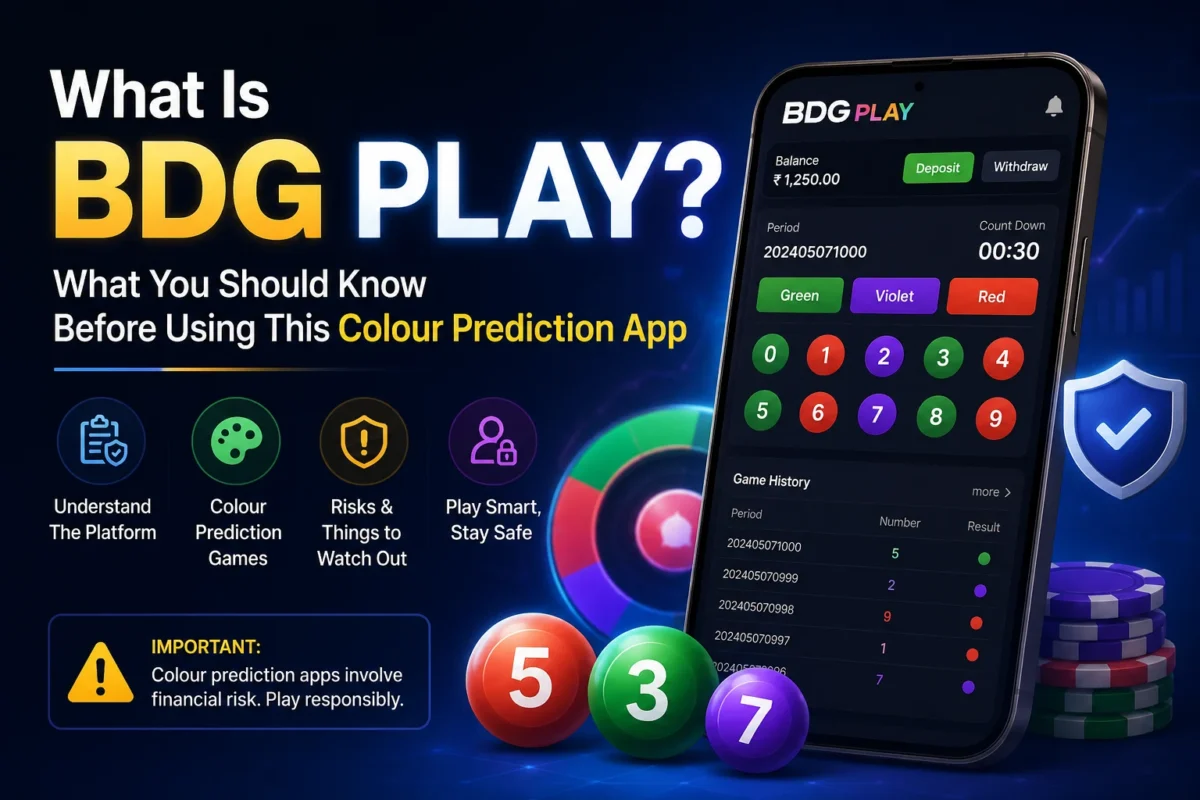
What Is BDG Play? What You Should Know Before Using This Colour Prediction App

If you’ve landed on gamesbdg.com or seen “BDG Play” advertised through a WhatsApp forward, an Instagram reel, or a Telegram link promising a welcome bonus of up to ₹10,000, you’re looking at one of the most widely shared colour prediction platforms in India right now. It’s part of the same family as BDG Game, BDG Win, and “Big Daddy Game” — names that show up constantly in searches for “easy money apps” and “colour prediction games.”

Before you create an account or deposit a single rupee, it’s worth understanding exactly what BDG Play is, how it actually functions behind its colourful interface, and what existing users and independent reviewers have already found.

What Is BDG Play?

BDG Play is an online platform that offers real-money colour and number prediction games — most commonly Win Go, K3 Lottery, TRX Hash, and slot-style games. The basic idea across all of these is the same: you pick a colour or number, place a bet, and if your guess matches the outcome of that round, you win a multiple of your stake.

The site markets itself heavily around big numbers — claims of “5 lakh+ active players,” welcome bonuses, and a constantly scrolling list of “recent winners.” Signing up isn’t open-ended either; nearly every entry point on the page (the “Play Now” and “Download App” buttons) funnels you through a registration link that requires an invitation code, and that link typically points to a different domain (such as bdg4416.com) than the one you started on.

This setup — referral-only signup, a different backend domain, and aggressive bonus messaging — is consistent with the broader “BDG” family of apps that has been operating under various names (BDG Game, BDG Win, Big Daddy Game) for the past few years.

How Does BDG Play Actually Work?

On the surface, the gameplay loop is simple:

  1. Register using a mobile number and an invitation code.
  2. Deposit funds via UPI, Paytm, or similar instant payment methods.
  3. Pick a game mode — Win Go (colour/number prediction), K3 (dice-based prediction), TRX Hash, or slots — and choose a round length, often 30 seconds to a few minutes.
  4. Place a bet on a colour or number.
  5. If your prediction matches the round’s result, you receive a payout, typically 2x for a colour and higher multiples for rarer outcomes like violet.

What you can’t see is what actually decides each round’s outcome. There’s no published, independently audited random number generator, and no regulatory body checking whether outcomes are genuinely random. This is the single biggest difference between BDG Play and a licensed gaming product — and it’s the part most “how to win” content conveniently skips over.

Is BDG Play Legitimate, or Is It a Scam?

This is the question most people searching for BDG Play actually want answered, so here’s a direct look at the evidence.

Independent reviews are not favourable. Reviewers who’ve examined BDG-branded apps in detail have generally concluded that the platform lacks transparency, providing no registration details, hiding information about its founders, and operating without visible contact details — and have categorised it as a fraudulent scheme rather than a legitimate earning platform.

User complaints follow a consistent pattern. Reported issues for BDG-style platforms commonly include deposits going missing and withdrawals being blocked, with the app reportedly using hidden algorithms designed to ensure the platform earns more than it pays out.

Withdrawal problems are widely reported. Independent investigations into BDG Win — part of the same app family — found cases where deposits stayed missing for months despite users submitting proof of payment and repeated support tickets, along with a recurring sequence where early small wins encourage bigger deposits, and larger withdrawal requests then stay stuck in “processing” indefinitely while support goes quiet.

Trust-monitoring sites flag it as high risk. Third-party trust services have given BDG Win very low scores, citing a lack of transparency around company details and licensing, content that’s effectively gambling despite being marketed as “gaming,” and payout problems as the most common complaint across review platforms.

Brand cloning adds another layer of risk. Cyber police in Goa uncovered a network of look-alike websites impersonating the official Big Daddy Casino brand to funnel users toward BDG Win-style platforms — meaning even people trying to find a “genuine” version of this app can end up on a clone built purely to collect deposits.

Taken together, this isn’t a case of one bad review — it’s a recurring pattern across multiple independent sources, over an extended period, describing the same core problems: no transparency, no licensing, and difficulty getting money back out.

Is BDG Play Legal in India?

Colour prediction platforms like BDG Play sit in a legal grey zone that’s much darker than the marketing suggests.

Online betting and gambling are illegal in most Indian states, and BDG Play does not appear to hold any licence, which puts its legality firmly in question. States including Telangana, Andhra Pradesh, Assam, and Odisha have explicit, strict bans on online gambling activity. Because platforms like this aren’t registered with the RBI, SEBI, or any other Indian financial regulator, there’s effectively no official body you can turn to if your withdrawal gets stuck or your account is suddenly disabled.

It’s also worth knowing that many platforms in this category are believed to be run from offshore locations, with some pointing back to operators based in China — which is part of why customer support often goes quiet the moment something goes wrong.

Common Red Flags on the BDG Play Website

A few patterns are worth flagging specifically because they show up again and again on sites like this:

  • Referral-only registration — you can’t sign up without an invitation code, which turns every user into a recruiter for the next one.
  • A scrolling “recent winners” ticker with names and amounts that can’t be verified.
  • The registration button redirects to a different domain than the page you’re browsing.
  • No licensing information, company name, or regulatory disclosure anywhere on the site.
  • Promises of guaranteed-feeling returns through bonuses and “VIP” tiers, despite this being a game of chance.
  • Heavy reliance on Telegram and WhatsApp promotion rather than verified app-store listings.

If you see two or more of these on any platform — not just BDG Play — treat it as a serious financial risk rather than a legitimate opportunity.

What Should You Do If You’ve Already Deposited Money?

If you’ve already put money into BDG Play or a similar app and are having trouble withdrawing it:

  1. Stop depositing more money immediately — additional deposits will not unlock a stuck withdrawal; this is a common manipulation tactic, not a genuine fix.
  2. Report it on the National Cyber Crime Reporting Portal at cybercrime.gov.in, or call the helpline at 1930.
  3. Inform your bank’s fraud department about the transactions and ask them to flag the activity.
  4. File a complaint at your nearest cyber crime police station, with screenshots of deposits, withdrawal requests, and any chat conversations with “support” or referral contacts.
  5. Never pay an additional “fee” or “tax” that a support agent claims will release your winnings — this is a near-universal scam tactic, not a real requirement.

Final Verdict: Should You Use BDG Play?

Based on the consistent pattern across independent reviews, user complaints, and the platform’s own design choices — referral-only signup, no licensing disclosure, and a long trail of withdrawal complaints tied to the same “BDG” app family — BDG Play carries significant financial risk. The flashy welcome bonuses and “5 lakh+ players” claims are marketing, not evidence of fairness or reliability.

If you’re looking for online entertainment, regulated and transparent alternatives exist that disclose licensing and ownership information clearly. For real-money platforms, that transparency isn’t a minor detail — it’s the entire difference between a legitimate product and a trap.

Frequently Asked Questions

Is BDG Play safe to use? Independent reviews and user complaints associated with the broader BDG app family point to significant risk, including missing deposits, blocked withdrawals, and a lack of any licensing or company transparency.

Is BDG Play legal in India? It operates in a legal grey area at best. Online betting and gambling are banned or heavily restricted in many Indian states, and BDG Play does not appear to hold any government licence or regulatory registration.

Can you really win money on BDG Play? Some users report small wins, especially early on. However, the recurring pattern across reviews is that early wins encourage larger deposits, after which significant withdrawals frequently get stuck or blocked entirely.

Why does BDG Play need an invitation code to sign up? The invitation/referral code system turns existing users into recruiters, which is how these platforms grow quickly through WhatsApp and Telegram without any traditional advertising.

Why does the BDG Play registration link go to a different website? Operators frequently run the actual platform on a separate, rotating domain (such as bdg4416.com) so that when one domain gets blocked or blacklisted, the business can continue operating under a new one with minimal disruption.

What happens if my withdrawal is stuck on BDG Play? This is one of the most frequently reported issues with BDG-style apps. Avoid depositing more money to “unlock” it, document everything, and report the issue through the National Cyber Crime Reporting Portal (cybercrime.gov.in) or helpline 1930.

Will I get in trouble with police if I used BDG Play and lost money? Generally, no. Users who lost money are typically treated as victims of a larger scheme rather than as offenders, even in cases where bank accounts get flagged during a wider investigation into the operators.

Are there safer alternatives to BDG Play? Yes. Look for platforms that clearly disclose company ownership, hold relevant licences, and are recognised by bodies such as DPIIT for skill-based gaming — and always verify those claims independently rather than trusting the platform’s own claims.


This article is for informational and educational purposes only and does not constitute legal or financial advice. If you are dealing with financial loss or an active fraud case, consult a qualified cyber-fraud lawyer or contact the National Cyber Crime Reporting Portal.

Categories
Colour Prediction Apps

Colour Prediction Apps in India: What You Actually Need to Know Before You Tap “Play”

If you’ve spent any time on Instagram, Telegram, or WhatsApp lately, chances are you’ve seen it — a flashy banner promising you can “predict a colour and win real cash,” with screenshots of strangers supposedly cashing out thousands of rupees. Apps with names like Win Go, K3, TRX Hash, Daman, or 91 Club have been popping up (and disappearing, and reappearing under new names) across Indian app stores, Telegram groups, and referral links for the past few years.

They’re easy to dismiss as harmless fun. They’re not. Behind the bright colours and “5 lakh+ players” claims sits a pattern that cyber-crime police, financial lawyers, and victims themselves have flagged again and again: these platforms are built to take money from users, not to pay it out fairly.

This guide breaks down how colour prediction apps actually work, why they keep multiplying despite being illegal in most of the country, what happens to the people who lose money on them, and what you can do if you’re already caught up in one.

What Is a Colour Prediction App, Exactly?

At its simplest, a colour prediction app asks you to guess an outcome — usually a colour (red, green, or violet) or a number — from a short list of options. If you guess right, you win a multiple of your bet. If you guess wrong, you lose your stake. Some versions wrap this in the language of “lottery,” “trading,” or “prediction gaming” to sound less like gambling than it is.

Despite the rebranding, the mechanics are gambling in every sense that matters: you put money in, an unverifiable algorithm decides the outcome, and the platform keeps a cut either way.

The games are usually styled as fast, repetitive rounds — often one every few minutes — designed to keep you playing far longer than a single bet would suggest.

How These Apps Actually Work Behind the Scenes

This is the part most users never see, and it’s the part that matters most.

There’s no independent fairness check. Licensed casinos and lottery operators are required to use audited random number generators and publish odds. Colour prediction apps publish nothing. There is no regulator checking whether “red” really has a 50% chance of coming up, because there’s no regulator involved at all.

Outcomes can be adjusted by the platform. Investigations into similar apps have repeatedly found that results are generated server-side, with no way for a player to verify they weren’t simply set to produce a loss. Several users who spoke with journalists described an identical, deliberate pattern: small wins early on to build confidence, followed by mounting losses once larger bets were placed.

The “instant rich friend” upsell is part of the design. A common entry point is a friendly stranger on WhatsApp or Telegram who walks a new user through their first deposit, “coaches” them through a couple of small early wins, and then quietly disappears once the user starts depositing larger amounts.

Referral codes turn users into recruiters. Almost every one of these platforms — including the BDG-style sites currently circulating — requires an invitation or referral code to sign up. This isn’t a loyalty programme; it’s a growth engine. Each new user is incentivised to bring in more users, which is why these links spread so fast through family and friend groups, and why the platforms can scale to hundreds of thousands of “players” with almost no advertising spend.

The testimonials are not verifiable. Scrolling tickers showing “Rahul K. won ₹4,200” or “Priya S. won ₹8,500” are a standard design pattern on these sites. There is no way to confirm any of these wins happened, who these people are, or whether the names are real.

Is It Actually Legal?

Short answer: in most of India, no — and even where the law is unclear, the practical risk to you is real either way.

Online betting and gambling are illegal or heavily restricted in the majority of Indian states. Online betting and gambling are illegal in most Indian states, which makes these apps unlawful and unsafe by definition. States including Telangana, Andhra Pradesh, and Tamil Nadu have explicit laws banning online betting platforms, and several have actively prosecuted operators and promoters.

This isn’t theoretical. In June 2024, Haryana’s Palwal Cyber Crime Police arrested two people for running the Tiranga colour trading app, after the pair promoted it through social media and misleading content; investigators found the platform was run by people based abroad, with money moved through Indian bank accounts. That single case captures the typical structure: a foreign-based operation, local promoters recruited online, and Indian bank accounts used to move the money.

Because the apps themselves are unlicensed, colour-prediction platforms generally have no registration with SEBI, RBI, or any other recognised financial regulator in India, despite offering activities that closely resemble betting and gambling without any legal sanction.

There’s also a less obvious legal risk that catches honest users off guard. When investigators move against one of these operations, agencies such as the state cyber police or the Enforcement Directorate typically respond by tracing the money trail and instructing banks to freeze every account that sent or received funds connected to the scheme — which can mean hundreds or thousands of ordinary players’ accounts get frozen, even though the real target is the operators behind it. If that happens, you may be asked to explain your transactions even though you were a player, not an organiser. The good news, according to legal guidance on these cases, is that someone who merely played the game and lost money is treated as a victim of the larger scheme, not as a criminal, and is very unlikely to face imprisonment for that alone.

Why Do These Apps Keep Coming Back Under New Names?

If you’ve noticed that the registration link on a colour-prediction landing page often points to a completely different domain than the one you searched — that’s deliberate.

Operators run these platforms on disposable domains specifically so they can outrun blacklisting, app-store takedowns, and police notices. When one domain gets reported or blocked, the operator simply spins up a near-identical site under a new name, often keeping the same referral infrastructure and sometimes even the same backend. This is part of why you’ll see near-clones of the same basic product — Win Go, K3, TRX Hash-style games — recurring under dozens of different brand names over the years.

It also explains why so many of these apps lean so heavily on Telegram and WhatsApp instead of app stores: colour prediction platforms running through Telegram channels operate outside official app-store oversight, which is part of why they’re able to keep functioning despite being fully illegal in India.

What Happens When People Lose Money

The human cost of these platforms is the part that rarely makes it into the flashy ads.

One IT employee in Bengaluru was introduced to a colour prediction app through an Instagram link promising at least a 10% return on correctly predicting a colour, and after an initial win of ₹20,000 on a ₹10,000 bet, went on to place bets totalling ₹5.5 lakh. The early win is rarely an accident — it’s what keeps people in the game long enough to bet amounts they can’t afford to lose.

Reporting losses doesn’t always go smoothly, either. A Chennai victim who lost ₹1.73 lakh on one of these apps did file a case with the Adyar cyber crime police, but said he was mocked by the investigating officer rather than taken seriously, even after providing the UPI account details involved in the transactions. That kind of experience discourages other victims from coming forward at all, which in turn helps these platforms keep operating with little accountability.

Withdrawal problems are another recurring theme. A common pattern described across consumer complaint forums is straightforward: deposits are processed instantly, but withdrawal requests stall, get rejected, or require yet another “fee” or “tax” payment before funds are released — a payment that, once made, still doesn’t unlock the money.

How to Spot a Colour Prediction Scam Before You Sign Up

A few warning signs show up again and again across these platforms:

  • No licensing or regulatory information anywhere on the site. Legitimate gaming and lottery operators display their licence number. These apps don’t, because they don’t have one.
  • Sign-up only works through a referral or invitation code. This is a recruitment structure, not a normal user onboarding flow.
  • A scrolling list of “recent winners” with no way to verify any of it.
  • The registration link sends you to a completely different domain than the one you were originally browsing.
  • Promises of guaranteed or near-guaranteed returns (“minimum 10% return,” “win every time with our strategy”) — no legitimate game of chance can promise this.
  • A “helper” who contacts you personally on WhatsApp or Telegram to walk you through your first deposit.
  • Easy deposits, painful withdrawals — especially any request for an extra payment to “unlock” your winnings.

If a platform shows two or more of these signs, treat it as a financial risk, not an opportunity.

What to Do If You’ve Already Lost Money

If you’ve already deposited money into one of these platforms, acting quickly matters more than feeling embarrassed about it.

  1. Report it on the National Cyber Crime Reporting Portal at cybercrime.gov.in, or call the helpline at 1930. This is the formal first step recommended for anyone who has lost money to a fraudulent app.
  2. Contact your bank’s fraud department immediately and ask them to flag the transactions. Chargebacks on these payments are rare, but early reporting improves your odds and helps build the broader case against the operator.
  3. File a complaint at your nearest cyber police station, bringing screenshots, transaction records, and any referral or chat messages you have.
  4. If your bank account gets frozen during a wider investigation, don’t panic. Being a player who lost money is a very different legal position from being an operator, and cooperating with the investigation is usually the fastest way to resolve it.
  5. Talk to a cyber-fraud lawyer if things escalate, particularly if you’re asked to explain account activity as part of a larger probe.
A Note If Gambling Losses Are Affecting You Personally

If money lost to one of these apps is creating serious financial pressure, family conflict, or distress, you’re not alone in that, and it’s worth talking to someone rather than carrying it by yourself — a counsellor, a trusted family member, or a helpline. This is a sensitive area, and reaching out early tends to help more than trying to “win it back” to fix the damage.

Frequently Asked Questions

Are colour prediction apps like Win Go or K3 actually illegal in India? In most Indian states, yes. Online betting and gambling are banned or heavily restricted across the majority of states, and several state cyber-crime units have already made arrests connected to colour prediction platforms.

Can the app really control who wins or loses? There’s no independent audit of these platforms’ algorithms, and multiple user accounts describe a consistent pattern of early small wins followed by losses once larger bets are placed — which is exactly what you’d expect if outcomes aren’t genuinely random.

Why do I need a referral code to sign up? Referral codes turn existing users into recruiters for new ones. It’s a growth strategy, not a loyalty reward, and it’s a major reason these platforms spread so quickly through friend and family networks.

I already lost money — will I get in trouble with the police? Generally no. Players who lost money are treated as victims of the broader scheme, not as criminals, even if their bank account gets temporarily flagged during a wider investigation into the operators.

Can I get my money back? It’s difficult, but not impossible. Reporting quickly to your bank and the National Cyber Crime Reporting Portal (cybercrime.gov.in, helpline 1930) gives you the best realistic chance, especially if the transactions are reported before the operator moves the funds further.

Why do these apps keep reappearing under new names? Operators deliberately run these platforms on disposable domains so that when one site is blocked or blacklisted, they can relaunch an identical product under a new name with minimal disruption.

Is there any version of a colour prediction app that’s safe to use? If a platform isn’t licensed by a recognised Indian gaming or financial regulator, has no verifiable company information, and relies on referral codes to onboard users, there’s no safe way to use it for real-money betting.


This article is for educational purposes and does not constitute legal or financial advice. If you are dealing with an active fraud case or significant financial loss, consult a qualified cyber-fraud lawyer or contact the National Cyber Crime Reporting Portal.