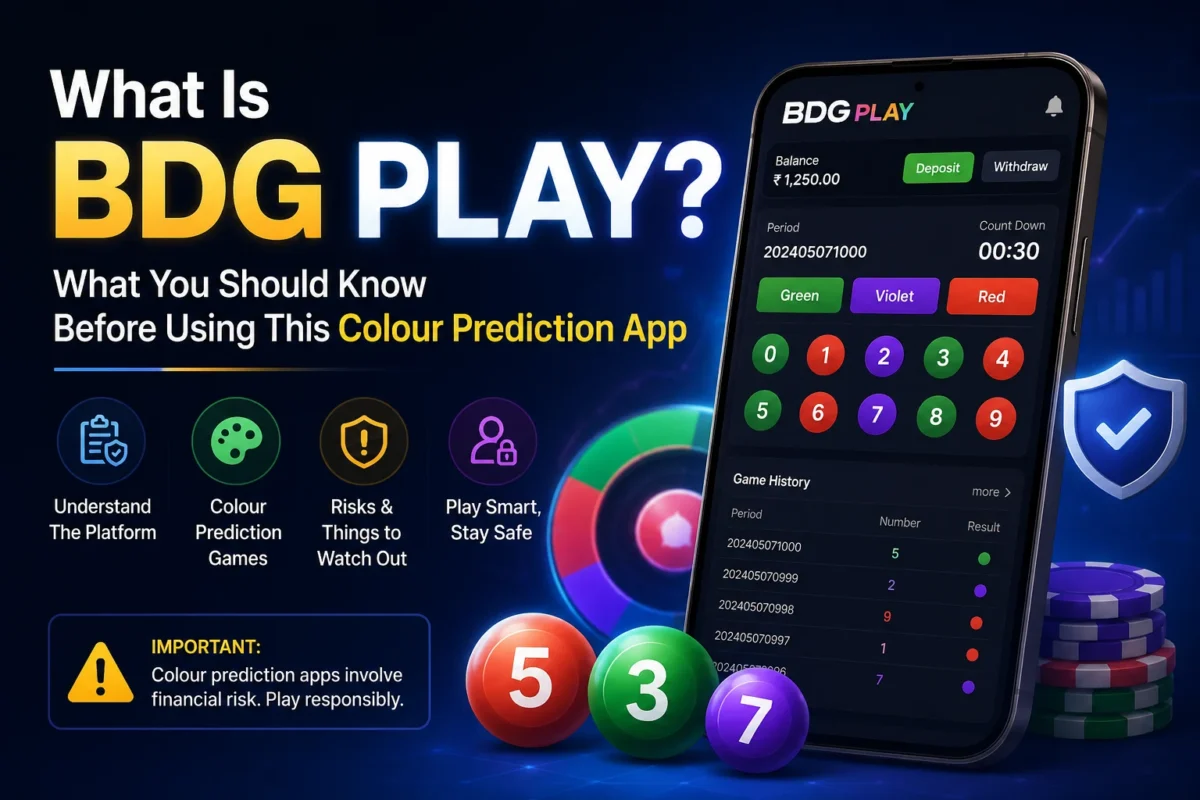
If you’ve landed on gamesbdg.com or seen “BDG Play” advertised through a WhatsApp forward, an Instagram reel, or a Telegram link promising a welcome bonus of up to ₹10,000, you’re looking at one of the most widely shared colour prediction platforms in India right now. It’s part of the same family as BDG Game, BDG Win, and “Big Daddy Game” — names that show up constantly in searches for “easy money apps” and “colour prediction games.”
Before you create an account or deposit a single rupee, it’s worth understanding exactly what BDG Play is, how it actually functions behind its colourful interface, and what existing users and independent reviewers have already found.
What Is BDG Play?
BDG Play is an online platform that offers real-money colour and number prediction games — most commonly Win Go, K3 Lottery, TRX Hash, and slot-style games. The basic idea across all of these is the same: you pick a colour or number, place a bet, and if your guess matches the outcome of that round, you win a multiple of your stake.
The site markets itself heavily around big numbers — claims of “5 lakh+ active players,” welcome bonuses, and a constantly scrolling list of “recent winners.” Signing up isn’t open-ended either; nearly every entry point on the page (the “Play Now” and “Download App” buttons) funnels you through a registration link that requires an invitation code, and that link typically points to a different domain (such as bdg4416.com) than the one you started on.
This setup — referral-only signup, a different backend domain, and aggressive bonus messaging — is consistent with the broader “BDG” family of apps that has been operating under various names (BDG Game, BDG Win, Big Daddy Game) for the past few years.
How Does BDG Play Actually Work?
On the surface, the gameplay loop is simple:
- Register using a mobile number and an invitation code.
- Deposit funds via UPI, Paytm, or similar instant payment methods.
- Pick a game mode — Win Go (colour/number prediction), K3 (dice-based prediction), TRX Hash, or slots — and choose a round length, often 30 seconds to a few minutes.
- Place a bet on a colour or number.
- If your prediction matches the round’s result, you receive a payout, typically 2x for a colour and higher multiples for rarer outcomes like violet.
What you can’t see is what actually decides each round’s outcome. There’s no published, independently audited random number generator, and no regulatory body checking whether outcomes are genuinely random. This is the single biggest difference between BDG Play and a licensed gaming product — and it’s the part most “how to win” content conveniently skips over.
Is BDG Play Legitimate, or Is It a Scam?
This is the question most people searching for BDG Play actually want answered, so here’s a direct look at the evidence.
Independent reviews are not favourable. Reviewers who’ve examined BDG-branded apps in detail have generally concluded that the platform lacks transparency, providing no registration details, hiding information about its founders, and operating without visible contact details — and have categorised it as a fraudulent scheme rather than a legitimate earning platform.
User complaints follow a consistent pattern. Reported issues for BDG-style platforms commonly include deposits going missing and withdrawals being blocked, with the app reportedly using hidden algorithms designed to ensure the platform earns more than it pays out.
Withdrawal problems are widely reported. Independent investigations into BDG Win — part of the same app family — found cases where deposits stayed missing for months despite users submitting proof of payment and repeated support tickets, along with a recurring sequence where early small wins encourage bigger deposits, and larger withdrawal requests then stay stuck in “processing” indefinitely while support goes quiet.
Trust-monitoring sites flag it as high risk. Third-party trust services have given BDG Win very low scores, citing a lack of transparency around company details and licensing, content that’s effectively gambling despite being marketed as “gaming,” and payout problems as the most common complaint across review platforms.
Brand cloning adds another layer of risk. Cyber police in Goa uncovered a network of look-alike websites impersonating the official Big Daddy Casino brand to funnel users toward BDG Win-style platforms — meaning even people trying to find a “genuine” version of this app can end up on a clone built purely to collect deposits.
Taken together, this isn’t a case of one bad review — it’s a recurring pattern across multiple independent sources, over an extended period, describing the same core problems: no transparency, no licensing, and difficulty getting money back out.
Is BDG Play Legal in India?
Colour prediction platforms like BDG Play sit in a legal grey zone that’s much darker than the marketing suggests.
Online betting and gambling are illegal in most Indian states, and BDG Play does not appear to hold any licence, which puts its legality firmly in question. States including Telangana, Andhra Pradesh, Assam, and Odisha have explicit, strict bans on online gambling activity. Because platforms like this aren’t registered with the RBI, SEBI, or any other Indian financial regulator, there’s effectively no official body you can turn to if your withdrawal gets stuck or your account is suddenly disabled.
It’s also worth knowing that many platforms in this category are believed to be run from offshore locations, with some pointing back to operators based in China — which is part of why customer support often goes quiet the moment something goes wrong.
Common Red Flags on the BDG Play Website
A few patterns are worth flagging specifically because they show up again and again on sites like this:
- Referral-only registration — you can’t sign up without an invitation code, which turns every user into a recruiter for the next one.
- A scrolling “recent winners” ticker with names and amounts that can’t be verified.
- The registration button redirects to a different domain than the page you’re browsing.
- No licensing information, company name, or regulatory disclosure anywhere on the site.
- Promises of guaranteed-feeling returns through bonuses and “VIP” tiers, despite this being a game of chance.
- Heavy reliance on Telegram and WhatsApp promotion rather than verified app-store listings.
If you see two or more of these on any platform — not just BDG Play — treat it as a serious financial risk rather than a legitimate opportunity.
What Should You Do If You’ve Already Deposited Money?
If you’ve already put money into BDG Play or a similar app and are having trouble withdrawing it:
- Stop depositing more money immediately — additional deposits will not unlock a stuck withdrawal; this is a common manipulation tactic, not a genuine fix.
- Report it on the National Cyber Crime Reporting Portal at cybercrime.gov.in, or call the helpline at 1930.
- Inform your bank’s fraud department about the transactions and ask them to flag the activity.
- File a complaint at your nearest cyber crime police station, with screenshots of deposits, withdrawal requests, and any chat conversations with “support” or referral contacts.
- Never pay an additional “fee” or “tax” that a support agent claims will release your winnings — this is a near-universal scam tactic, not a real requirement.
Final Verdict: Should You Use BDG Play?
Based on the consistent pattern across independent reviews, user complaints, and the platform’s own design choices — referral-only signup, no licensing disclosure, and a long trail of withdrawal complaints tied to the same “BDG” app family — BDG Play carries significant financial risk. The flashy welcome bonuses and “5 lakh+ players” claims are marketing, not evidence of fairness or reliability.
If you’re looking for online entertainment, regulated and transparent alternatives exist that disclose licensing and ownership information clearly. For real-money platforms, that transparency isn’t a minor detail — it’s the entire difference between a legitimate product and a trap.
Frequently Asked Questions
Is BDG Play safe to use? Independent reviews and user complaints associated with the broader BDG app family point to significant risk, including missing deposits, blocked withdrawals, and a lack of any licensing or company transparency.
Is BDG Play legal in India? It operates in a legal grey area at best. Online betting and gambling are banned or heavily restricted in many Indian states, and BDG Play does not appear to hold any government licence or regulatory registration.
Can you really win money on BDG Play? Some users report small wins, especially early on. However, the recurring pattern across reviews is that early wins encourage larger deposits, after which significant withdrawals frequently get stuck or blocked entirely.
Why does BDG Play need an invitation code to sign up? The invitation/referral code system turns existing users into recruiters, which is how these platforms grow quickly through WhatsApp and Telegram without any traditional advertising.
Why does the BDG Play registration link go to a different website? Operators frequently run the actual platform on a separate, rotating domain (such as bdg4416.com) so that when one domain gets blocked or blacklisted, the business can continue operating under a new one with minimal disruption.
What happens if my withdrawal is stuck on BDG Play? This is one of the most frequently reported issues with BDG-style apps. Avoid depositing more money to “unlock” it, document everything, and report the issue through the National Cyber Crime Reporting Portal (cybercrime.gov.in) or helpline 1930.
Will I get in trouble with police if I used BDG Play and lost money? Generally, no. Users who lost money are typically treated as victims of a larger scheme rather than as offenders, even in cases where bank accounts get flagged during a wider investigation into the operators.
Are there safer alternatives to BDG Play? Yes. Look for platforms that clearly disclose company ownership, hold relevant licences, and are recognised by bodies such as DPIIT for skill-based gaming — and always verify those claims independently rather than trusting the platform’s own claims.
This article is for informational and educational purposes only and does not constitute legal or financial advice. If you are dealing with financial loss or an active fraud case, consult a qualified cyber-fraud lawyer or contact the National Cyber Crime Reporting Portal.